Emergency Garage Door Repair Near Me: What Lakewood Homeowners Should Do First
When a garage door fails in Lakewood, the first fifteen minutes decide whether you’re looking at a modest repair or a bill that’s several times higher. Most homeowners make it worse by forcing the door, unhooking the wrong part, or leaving the opening exposed all night. The fix is a simple three-step response, done in order. If you’d rather not take that on yourself, call (833) 968-4997 and we’ll walk you through it or send help.
Here’s the thing we’ve learned after years of spring and cable work: a snapped cable isn’t the expensive part. Forcing a door down after a cable lets go is. It bends the bottom bracket, warps the track, and turns a straightforward cable replacement into a much bigger job. The door doesn’t need your muscle. It needs you to stop and look.
Your First Three Steps After a Garage Door Fails
Stop operating the door. Then figure out what actually broke. Then secure the opening. That order matters, and here’s why.
1. Stop operating the door. Press the button once more, or tug the handle, and you can convert a broken spring into a bent track or a snapped cable into a twisted section panel. The door is now a heavy object that’s being asked to move without the counterbalance it was designed around. Every cycle stresses the parts that are still intact. Leave it where it sits.
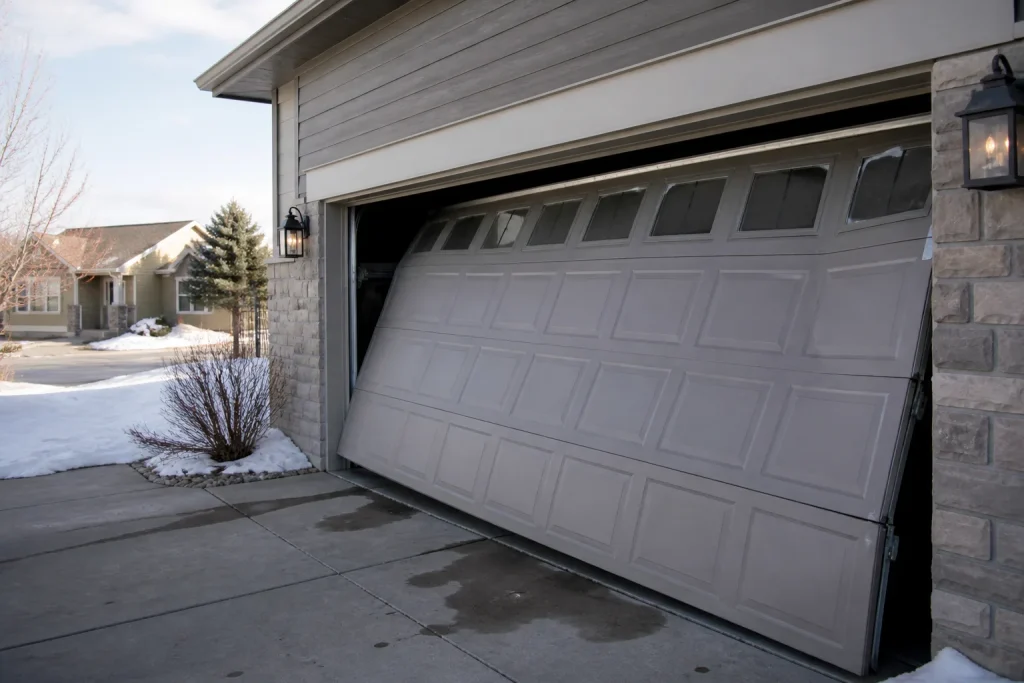
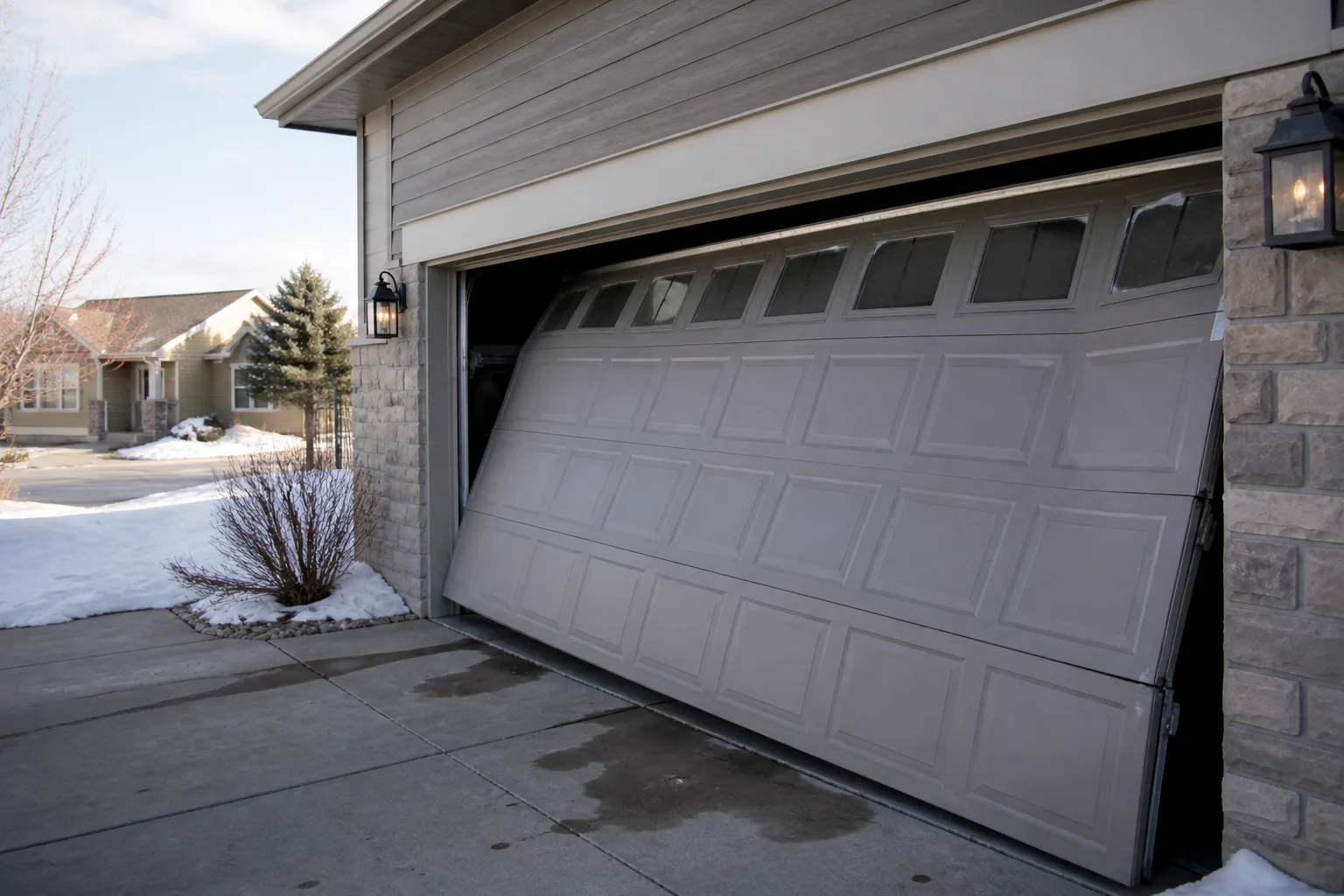
2. Assess which component failed, visually only. Stand back and look, don’t touch. A torsion spring lives on the shaft above the door; an extension spring runs along each side. If you see a clear gap in the coil, the spring has let go. A cable that’s come off its drum will show slack or a loose strand hanging near the bottom corner. A door that’s jumped its track sits at an angle, with a roller out of the channel. You’re gathering information for a phone call, not attempting a repair.
3. Secure the opening. If the door is stuck open, the garage is exposed. If it’s stuck shut, your car may be trapped. Either way, the door itself should be treated as immovable until a technician looks at it. In Lakewood, that may mean a night with the garage bay open to the alley, which is the part homeowners underestimate.
None of this takes long. It just needs doing in the right order.
How Do You Disconnect a Garage Door From the Opener Safely?
Pull the red emergency release handle only when the door is fully closed and the springs are intact. That single rule prevents most of the injuries we hear about.
Most openers have a red T-handle hanging from the trolley. Pull it and the door separates from the rail, letting you lift it by hand. That’s the design. The trouble starts when someone pulls that handle on a door with a broken spring or a snapped cable.
Here’s the risk: the opener is doing some of the lifting. The springs do most of it. When you release the trolley on a door with a failed spring, the full weight of the door is suddenly held by whatever’s left of the counterbalance, which may be nothing. The door can drop hard. Panels slam. Fingers and feet get caught. People have been seriously hurt this way.
Two more rules worth knowing:
- Never pull the release while the door is up. The door can free-fall, and it’s a heavy object with sharp edges.
- Never try to release the spring tension yourself. Torsion springs are wound under load. Loosening the set screws without the correct winding bars and the training to use them can turn a spring into a projectile. Springs are under serious tension, and this is a job for a trained technician.
If you can’t tell whether the springs are intact, don’t touch the red handle. Call us instead. And if your opener itself is the problem, that’s a separate conversation – our garage door opener repair team handles everything from a dead Craftsman motor to a LiftMaster that won’t sync.
How Do You Secure a Garage Door Stuck Open in Lakewood Overnight?
Use a brace across the opening, not a hope and a bit of tape. A door stuck open creates a real security gap, and improvised fixes can create their own problems.
The good options are straightforward. Close and lock any interior door between the garage and the house. Move tools, bikes, and anything valuable out of sight or into a locked closet. If the door is stuck partway, wedge a sturdy board under the bottom section so it can’t slide further. A length of 2×4 across the inside of the opening, screwed to the studs, holds a stuck panel in place more reliably than anything you’ll find in a kitchen drawer. It comes out easily when the technician arrives.
The options that cause trouble:
- Propping the door with a chair or a broom handle. The door outweighs it, and when it lets go, the door bends and whatever was under it breaks.
- Pulling the release to “close it manually.” On a door with compromised springs, that’s the injury scenario above.
- Blocking the opening from the outside with a car or a stack of boxes. The car’s insurance may not cover a garage door that falls on it, and you’ve created a bigger dent in your evening.
In Lakewood, a door that’s stuck open overnight is a security question as much as a repair question. Do the simple, reversible things and leave the door itself alone.
What Counts as a True Garage Door Emergency?
A true emergency is a door that’s a danger or a trap: broken spring with the car stuck inside, a door off its track that’s leaning or falling, or a door that won’t stay up and could drop on someone walking under it. Everything else can wait for a scheduled visit.
In our experience, a lot of “emergency” calls are urgent but not dangerous. The distinction matters because it helps you calibrate cost and urgency. Here’s how we sort them:
- True emergency: a snapped spring with the car trapped inside, a door hanging off one track or tilted, a door that’s come down on something and won’t release, a torsion spring that’s broken while the door is up and the door is now stuck open.
- Urgent, not dangerous: the opener died, the remote stopped working, the door reverses halfway and comes back down, a keypad or wall button doesn’t respond, or a LiftMaster or Chamberlain unit is flashing an error code.
- Not urgent: a noisy door, a worn roller, a bottom seal that needs replacing, a panel that’s dented but the door still opens and closes.
For the second and third buckets, a scheduled visit works. For the first, tell the person on the phone exactly what’s happening so they know what to send. For doors that are off their track or damaged from a collision, that’s a repair call – our garage door repair team is set up for it.
What Should You Tell a Technician When You Call?
Four things cut diagnostic time in half: what the door is doing, what it sounded like, what brand and type it is, and what you’ve already tried. Tell us those and we can often tell you on the phone what’s likely wrong before we pull into your driveway.
- What the door is doing now. Stuck open, stuck closed, halfway, or operating but making a terrible noise. “It won’t close” and “it closes and then immediately goes back up” point to completely different things.
- What it sounded like when it failed. A sharp bang is often a spring. A grinding or scraping sound points to a roller or track. A dead silence when you press the button is usually the opener.
- The brand and type. Amarr, Wayne Dalton, Craftsman, and Raynor doors all have their quirks, and opener brands vary too – a Genie behaves differently from a LiftMaster when it reverses. Knowing the brand helps us bring the right parts on the first visit.
- What you’ve already tried. Did you pull the red handle? Did you press the wall button? Did you check the breaker? This saves us from chasing a problem you’ve already ruled out.
Add whether the car is trapped and whether the garage can be secured overnight, and you’ve given us everything we need to prioritize your call. That’s the whole point of the first fifteen minutes – making the next conversation shorter and the repair smaller.
When to Call a Pro
If the door is off its track, the spring has snapped, or you can’t tell what’s wrong from a safe distance, call. There’s nothing to gain by experimenting. Our technicians have up to 14 years of experience, and we work on the eight major brands we were trained to service: LiftMaster, Chamberlain, Genie, Clopay, Amarr, Wayne Dalton, Craftsman, and Raynor. Garage doors are the only thing we do, so we bring the right parts and know the quirks of the door you already own.
For anything on the opener side, or a full door replacement you’ve been putting off, that’s a scheduled visit rather than a same-day emergency, and we’ll quote it in writing before any work starts. You can see how a new door works at our garage door installation page.
Related services in Lakewood: garage door repair, opener repair, spring replacement, and full installation are all handled by the same specialist team.
The Bottom Line
The first fifteen minutes are about doing less, not more. Stop running the door. Look before you touch. Secure the opening in a way you can undo. And when you call, bring four facts: the current state, the sound it made, the brand, and what you already tried.
If you’re in Lakewood and need help, Garage Door Repair Lakewood Pros offers free estimates – call (833) 968-4997. We’re the team the person at Garage Door Repair Lakewood Pros picks up the phone with, and we’ll tell you straight whether it’s an emergency or a scheduled repair.
Frequently Asked Questions
No. The spring carries most of the door’s weight, and without it the door is far heavier than it looks. Lifting it by hand risks injury and can bend the panels or twist the track. Leave it down and call for repair – the door, the springs, and the opener all need to be treated as one system until it’s inspected.
It depends on what failed. A cable or roller repair typically runs less than spring replacement, and opener diagnostics are their own category. The written estimate before work starts sets the final price, so you’ll know the number before we touch the door. Call (833) 968-4997 and we’ll give you a free estimate.
Because pulling the handle separates the door from the opener, and if the springs aren’t intact, the door won’t lift smoothly or safely. Re-engaging the trolley with the door in the wrong position can also damage the opener carriage. Leave the door down and call – we can walk you through whether it’s safe to reset or whether the door needs a spring inspection first.
Call a garage door specialist. Springs are under serious tension and need the right winding bars and training, and a general handyman usually doesn’t carry the torsion hardware, cables, or drums that a spring replacement involves. A specialist gets the door back in working order with the correct parts on the first visit.
Written by the team at Garage Door Repair Lakewood Pros.
Need Garage Door Help?
Call Garage Door Repair Lakewood Pros - the local pro we connect you with is licensed and insured, here with fast after-hours help in Lakewood.
(833) 968-4997